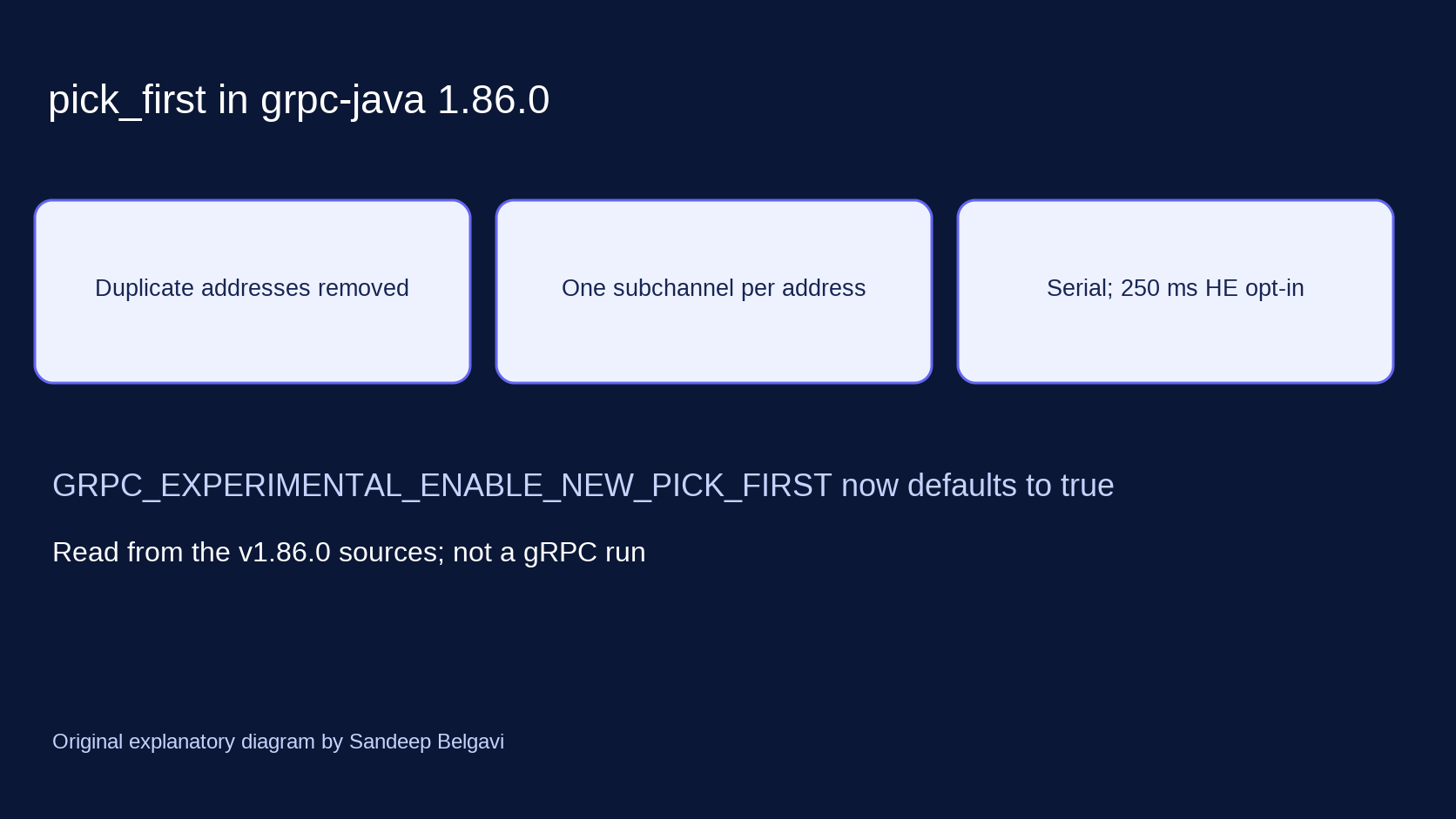
grpc-java 1.86.0 (24 November 2026) switches pick_first to one subchannel per address. Happy Eyeballs stays off. Rollback flags and an upgrade test plan.
One flag changed its default
gRPC Java 1.86.0 was released on 24 November 2026. Its release notes list, under behaviour changes, that the core module now enables the new Pick First Leaf load balancer, citing pull request 13114 and gRFC A62 and A61. The change itself is one line in PickFirstLoadBalancerProvider: the flag GRPC_EXPERIMENTAL_ENABLE_NEW_PICK_FIRST now defaults to true instead of false. The pull request was merged on 13 October, but 1.86.0 is the first release that ships it.
pick_first is the policy a channel uses when the service config does not choose another one, so this default reaches almost every gRPC Java client, including those that never configured load balancing. This guide reads the 1.86.0 sources to explain what the new balancer does differently, why the Happy Eyeballs behaviour that the release note mentions is still off, how to roll back, and what to test before upgrading. A companion timeline model and an interactive lab let you replay the connection attempts.
What the old and new balancers do
In 1.85.0, with the flag off, PickFirstLoadBalancer created a single subchannel from the entire resolved address list. The subchannel's transport tried the addresses in order, and the balancer saw only the subchannel's aggregate state.
PickFirstLeafLoadBalancer, the 1.86.0 default, works per address. It removes duplicate addresses, keeps an index into the flattened list and creates one subchannel per address as it tries them. Each subchannel has its own connectivity state and its own reconnect backoff. When the current address fails, the balancer moves to the next one. When every address has failed once, it reports TRANSIENT_FAILURE and asks the name resolver to refresh. After that first pass, a comment in the source explains, individual subchannels keep their own per-address backoff and the balancer requests a connection whenever one returns to IDLE, rather than walking the list again; a new address list from the resolver starts a fresh pass.
Both versions keep the channel in TRANSIENT_FAILURE until a connection succeeds, the sticky behaviour that gRFC A62 standardised, so callers that do not wait for readiness fail fast in both. What changes is mostly underneath: how many subchannels exist, how backoff is tracked, when re-resolution is requested and how the balancer reacts when the resolver sends a new list while it is connecting. The new balancer requests re-resolution when a READY connection goes IDLE, at the end of the first failed pass, and later when the count of failures reaches the number of addresses.
Happy Eyeballs is still off
The release note describes the leaf balancer as the rewrite designed for gRFC A61, which specifies Happy Eyeballs for dual-stack backends. It would be easy to read the note as turning Happy Eyeballs on. In 1.86.0 it does not. PickFirstLoadBalancerProvider still reads GRPC_PF_USE_HAPPY_EYEBALLS with a default of false, and the leaf balancer only uses Happy Eyeballs when that flag is true and a separate flag, GRPC_SERIALIZE_RETRIES, also false by default, is not set.
// From grpc-java v1.86.0, PickFirstLoadBalancerProvider (excerpt).
static boolean enableNewPickFirst =
    GrpcUtil.getFlag("GRPC_EXPERIMENTAL_ENABLE_NEW_PICK_FIRST", true);

public static boolean isEnabledHappyEyeballs() {
  return GrpcUtil.getFlag(GRPC_PF_USE_HAPPY_EYEBALLS, false);
}
With the flag on, the balancer interleaves the flattened address list by family, starting with the family of the first address, and starts a new connection attempt every 250 milliseconds while earlier attempts continue. The first attempt to reach READY wins and the others are shut down. In Java the 250 milliseconds is a constant, CONNECTION_DELAY_INTERVAL_MS. gRFC A61 allows implementations to expose the delay as a channel argument clamped between 100 milliseconds and 2 seconds, but the 1.86.0 Java code does not.
Replay the difference
The companion model replays the first pass for three synthetic address lists. The most instructive is a dual-stack name whose IPv6 path silently drops packets, so connection attempts time out, while IPv4 works. The model takes the connect timeout as an input, set to 20 seconds here.
IPv6 blackholed, list [v6 a, v6 b, v4 a, v4 b]
serial (1.86.0 default)       ready at 40,030 ms on 192.0.2.10:443, one attempt at a time
GRPC_PF_USE_HAPPY_EYEBALLS    ready at 280 ms on 192.0.2.10:443, two attempts in flight
Serial pick_first waits for both IPv6 attempts to time out before trying IPv4. With Happy Eyeballs, the interleaved order puts an IPv4 address second, its attempt starts at the 250 millisecond timer and connects 30 milliseconds later. When an attempt fails quickly, for example a refused connection, both modes move to the next address immediately, which is why a refused first address costs only a few milliseconds either way. When every address is down, both modes report TRANSIENT_FAILURE after the slowest failure and request re-resolution once.
Address order randomisation, also from gRFC A62, is unchanged by the switch: in 1.86.0 both balancers read shuffleAddressList from the pick_first load-balancing config and call the same shuffle method in PickFirstLeafLoadBalancer when it is true, which spreads clients across equivalent backends instead of piling every client onto the first address the resolver returns. That method weights the shuffle by endpoint weight attributes when a separate flag, GRPC_EXPERIMENTAL_PF_WEIGHTED_SHUFFLING, is on, which is its default. If you rely on the resolver's order, for example because the first address is a nearby replica, leave shuffling off and check that your resolver keeps returning that order.
Roll back if you need to
The flag is read by FeatureFlags.getFlag, which checks the environment variable first and falls back to a JVM system property of the same name. A blank value keeps the default; otherwise the value is parsed as a boolean.
# Use the 1.85-style balancer with grpc-java 1.86.0, either way:
GRPC_EXPERIMENTAL_ENABLE_NEW_PICK_FIRST=false
java -DGRPC_EXPERIMENTAL_ENABLE_NEW_PICK_FIRST=false -jar stock-client.jar

# Opt in to Happy Eyeballs in pick_first:
GRPC_PF_USE_HAPPY_EYEBALLS=true
Because the environment variable wins, a container image that sets it overrides whatever the application passes as a property. The flag's name includes EXPERIMENTAL, which suggests it is a transition switch rather than a permanent setting; plan to fix whatever made you roll back instead of keeping the old balancer indefinitely.
What to test before upgrading
Dual-stack clients first. If your resolver returns IPv6 addresses ahead of IPv4 and some networks drop IPv6 silently, serial pick_first already waited for timeouts in 1.85 and still does in 1.86. Measure time to first READY from those networks with and without GRPC_PF_USE_HAPPY_EYEBALLS, and decide whether to opt in.
Address lists with duplicates or many entries. The leaf balancer de-duplicates and creates subchannels per address, so channel-level metrics, Channelz views and any test that counts subchannels through a custom helper will see different numbers.
Custom load-balancing policies that delegate to pick_first. A parent policy that wraps pick_first now wraps the leaf implementation, including its health-check integration and per-address states. Run their tests against 1.86.0 before shipping.
Resolver behaviour. Re-resolution is requested at different points than before. If a custom name resolver is expensive or rate-limited, count its refresh calls under a failing backend in a staging test.
Other behaviour changes in the same release are smaller but worth a glance: service configs whose retryThrottling block omits maxTokens or tokenRatio now fail with an error naming the missing field rather than an unexplained null pointer message, Channelz counts client-cancelled server calls as failed, and the xDS client rejects duplicate endpoint addresses in EDS and fails a CDS cluster whose EDS update has no usable endpoints.
When the change will not matter
Clients that connect to a single address, such as a local sidecar or a load balancer VIP, see no difference in which address they use and little difference in timing. Services that already configure round_robin or an xDS policy do not use pick_first at the top level, although xDS leaf policies may use it underneath. For them the upgrade is mostly about the other release notes.
Verification
Before upgrading, log channel connectivity transitions in a staging client and compare 1.85.1 with 1.86.0 against the same address lists: one healthy, one with a dead first address, one dual-stack with a blackholed family. Count re-resolution requests from your resolver in the failing case. If you opt in to Happy Eyeballs, confirm that two attempts overlap in packet captures. The companion model encodes the source behaviour described here, not a gRPC run, and the general Happy Eyeballs algorithm is covered at /blogs/networking/net_happy_eyeballs.html.
Interactive experiment
gRPC pick_first attempts: per-address subchannels and Happy Eyeballs. Synthetic browser-local fixtures, adjustable inputs, decision traces and JSON export.