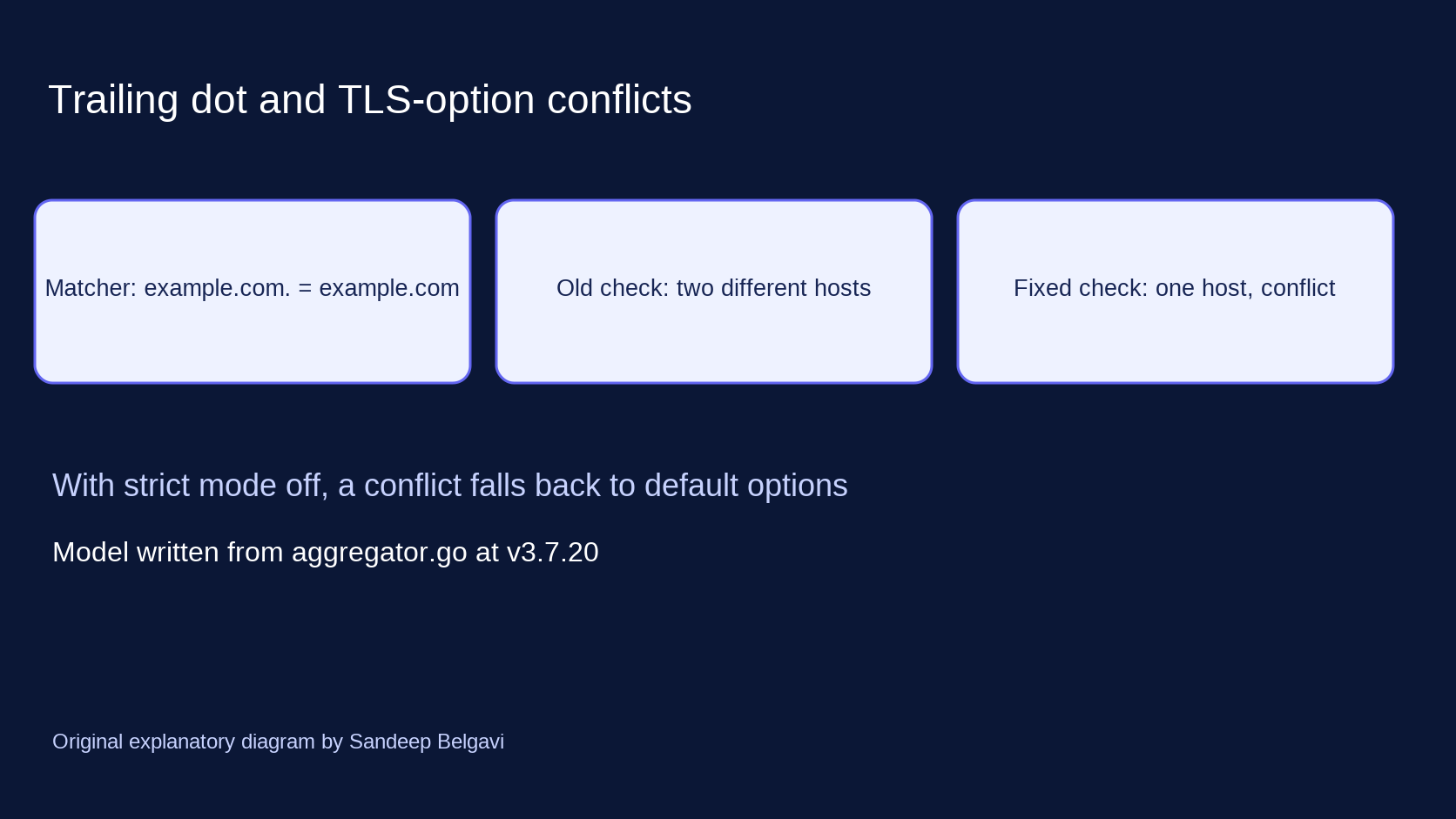
Traefik v3.7.20 and v3.8.0 (23 November 2026) fix GHSA-9657-c2gv-wjpj. With strictTLSOptions off, a detected conflict still downgrades the protected router.
The advisory
On 23 November 2026 Traefik released v2.11.64, v3.7.20 and v3.8.0. They fix three advisories, published on 24 November. This guide covers the one with the most instructive mechanism: GHSA-9657-c2gv-wjpj, rated medium, "Trailing-dot hosts evade TLS-option conflict detection". In the advisory's words, the Host and HostSNI matchers treat example.com. and example.com as the same host, but the conflict detection did not. So a router whose rule spells a host with a trailing dot could serve a host that another router protects with client-certificate TLS options. The conflict went undetected, and the routers were not put in error even with core.strictTLSOptions enabled. The advisory names who can exploit it: anyone who can define a router, such as a tenant of a shared Traefik instance. It describes the issue as a gap in the fixes for three earlier advisories, GHSA-j994-9gqj-9hwq, GHSA-g55h-rg46-x9c5 and GHSA-2272-4vv8-65ww.
Traefik v1 is not affected. The v3.0 to v3.6 lines are end of life and get no patch; the remedy is a patched v2.11, v3.7 or v3.8 release. The interactive lab replays the conflict logic for any set of routers, before and after the fix.
Why TLS options can conflict at all
The Traefik migration guide explains the constraint. TLS options such as minimum version, cipher suites and client authentication are configured on a router. They are applied during the TLS handshake, before any routing happens, so Traefik maps them to the host names in router rules rather than to routers. If two routers on the same entry point serve the same host name with different TLS options, Traefik cannot know which options a connection for that name should get.
What it does then depends on core.strictTLSOptions:
- Off, the default. The conflicting routers fall back to the
defaultTLS options. The guide warns that a router relying on mutual TLS no longer enforces it if a conflict on its host falls back todefaultoptions that do not require client certificates. - On, available since v3.7.11. The routers involved are marked in error and not built. The guide describes it as failing closed: a conflict disables all the routers serving that host name on that entry point until it is resolved.
The bug and the fix
The detection lives in findConflictingRouters in pkg/server/aggregator.go. For each entry point it parses the domains of every TLS router's rule, which are already lower-cased, and groups routers by host and by resolved TLS option. A host with more than one option group is a conflict. Before the fix, the grouping key was the domain exactly as written, so admin.bookstore.test and admin.bookstore.test. landed in different groups, and neither group had a second option.
PR 14192, merged into the v2.11 branch on 13 November and released in all three versions, adds one line before the grouping:
// The Host and HostSNI matchers ignore a trailing dot,
// so "example.com." and "example.com" are the same host.
domain = strings.TrimSuffix(domain, ".")
The tests added with it check both modes. Without strict mode, the two routers are rewritten as conflicted routers using default; with strict mode, both are marked conflicting.
Three outcomes for the same two routers
Take a shared instance at Belgavi's Book Store. The staff team's router staff-admin serves admin.bookstore.test with TLS options mtls-staff, which require a client certificate. A tenant can create routers and adds tenant-promo, whose Host rule names admin.bookstore.test. with a final dot, and the default options. The companion model trailing_dot_tls_conflicts and the lab compute:
| Version and mode | Conflict detected | Effective options | Result |
|---|---|---|---|
| v3.7.19, either mode | no | staff-admin: mtls-staff; tenant-promo: default | the same host is served by routers with different options, the condition the advisory describes |
| v3.7.20, strict off | yes | both: default | staff-admin loses its client-certificate requirement |
| v3.7.20, strict on | yes | both disabled | the admin host is unavailable until the tenant's router is removed |
The middle row is the point most readers of the advisory will miss. Upgrading closes the detection gap, but with the default setting the detected conflict is resolved by downgrading the protected router to the default options. On a shared instance where tenants can write routers, the fix alone turns a bypass into a downgrade that the tenant can trigger on purpose. Strict mode turns it into an outage the tenant can trigger instead. That is better, because it fails closed and is loud, but it is still a tenant affecting a host it does not own.
What to do
- Upgrade to v2.11.64, v3.7.20 or v3.8.0. v3.0 to v3.6 get no fix.
- Enable
core.strictTLSOptionson any instance where a router with weaker options could share a host with one that requires client certificates. It is install configuration; see the snippet after this list. - Make the
defaultTLS options safe to fall back to. The migration guide's own advice: they should not be less secure than the options they can replace. - Control who may claim a host. The lasting fix for multi-tenant routing is admission: a tenant may only create routers for hosts it owns. With the Kubernetes providers that means an admission policy on the route resources; with the file provider, review of rules by host. Normalize host names in that check, lower-casing and stripping one trailing dot, so the policy does not repeat the bug.
- Audit existing rules. The example's
audit()lists hosts written with a trailing dot and routers claiming a host assigned to another owner. - Watch the logs. Traefik logs an error naming the host and the routers when it detects a conflict. Alert on it: on a patched instance, a new conflict on a protected host is either a mistake or an attempt.
The strict setting in the install configuration file:
core:
  strictTLSOptions: true
The general lesson: compare names the way the matcher does
The bug class is old and appears wherever two components compare names. Here, one component normalized host names and another did not. Each was correct on its own, and the security property lived in the gap between them. The same shape appears with case folding, Unicode normalization, percent-encoding in paths, and IPv4 addresses written in other notations. When you write a check that guards a matcher, derive the check's comparison from the matcher's, ideally by calling the same normalization function, and add a test that feeds both components the same unusual spellings.
The other two advisories in the release
GHSA-3rh5-223h-cpwr, rated high, limits the memory of the Brotli writer in the Compress middleware. An unauthenticated client sending Accept-Encoding: br could keep many compressed responses in flight and exhaust the process memory. Traefik v2 is not affected because it does not support Brotli. GHSA-42x2-976f-ph52, rated medium, fixes the redaction of provider credentials, such as the Docker provider password and the HTTP provider headers, in debug logs, support dumps and anonymous usage statistics. If you ran with debug logging or shared a support dump, rotate those credentials.
Limits of the model
The model and lab follow the v3.7.20 source for HTTP routers and Host rules on one entry point per router, with unqualified option names. They do not model TCP routers with HostSNI, rule priorities, or how a client's SNI selects options during the handshake. The advisory does not spell out an exploit request path, and neither does this guide.
Interactive experiment
Trailing-dot hosts: router matching versus TLS-option conflict checks. Synthetic browser-local fixtures, adjustable inputs, decision traces and JSON export.