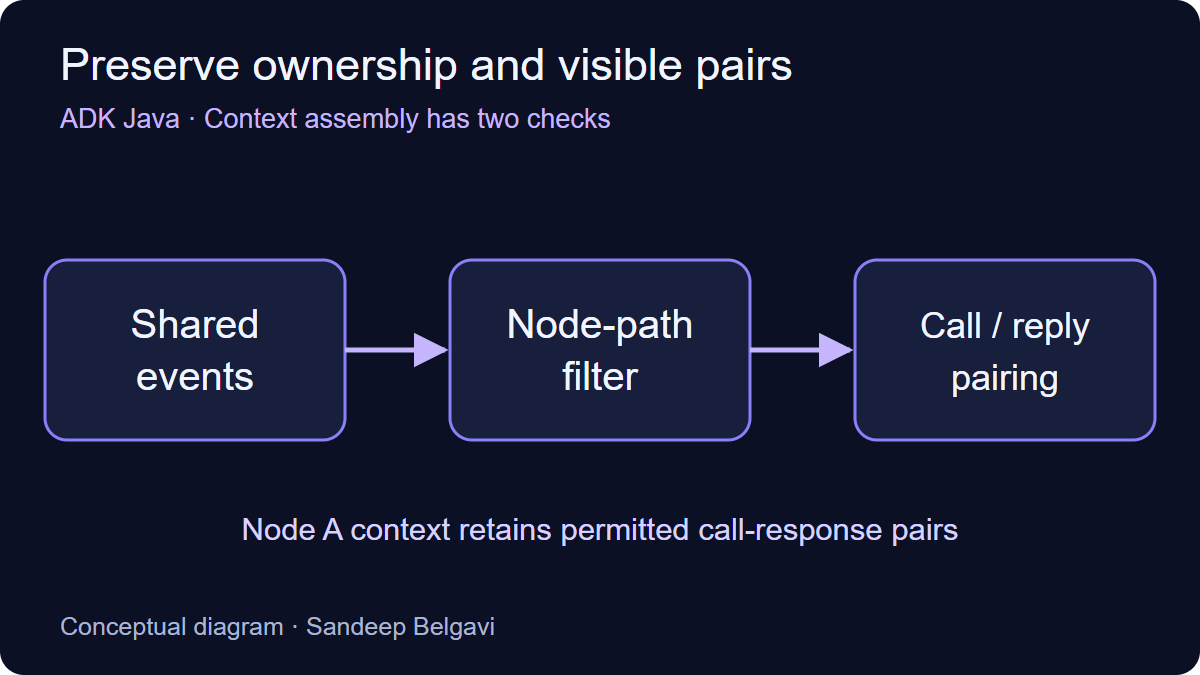
Three ADK Java main-branch commits on November 16, 2026 address context isolation and concurrent state transfer. They offer a concrete way to examine what an agent should see when several nodes share a session. The latest tagged release inspected for this review was v1.14.0 from November 2; do not assume that installing it includes these later changes.
An injected input belongs to a node
The input-isolation commit tracks framework-injected events by identity across an invocation and filters inputs associated with a different node path. Tracking persists after temporary removal so earlier snapshots can still recognize an input. Its tests distinguish injected inputs from a custom node's deliberately emitted user event.
That distinction matters when a shared event store supplies several views. Removing an item from the current collection does not necessarily remove it from a snapshot already held elsewhere. An ownership record needs a lifetime that covers those readers. Conversely, treating every user-shaped event as injected input would erase legitimate events that happened to use the same role.
Keep visible call and response relationships intact
A second commit scopes SINGLE_TURN history by node path, with ancestor retention depending on include-contents configuration. After branch filtering, it removes function-response parts without an earlier visible matching call. Tests include reused identifiers and response events containing answers for more than one branch.
This is a data-lineage problem as well as a text-filtering problem. An answer is meaningful because it refers to a call that the recipient can see. Hiding a sibling branch can leave an orphaned answer in an otherwise well-formed event. A response containing several parts also requires a finer decision than keeping or discarding the entire event.
Ordering belongs in that decision. A later call reusing an identifier should not retroactively make an earlier answer visible. A useful review artifact is a small table containing event order, node path, call identifier and visibility. The table exposes a relationship that a final transcript alone can make difficult to reconstruct.
A state write can arrive during transfer
The third commit replaces copying pending deltas followed by clearing the map with per-entry copying and conditional removal using the copied key and value. An intervening replacement remains pending. The change covers state and artifact deltas; a regression test checks a state write arriving during transfer.
Consider a synthetic timeline: a drain reads counter=1, another thread writes counter=2, then the drain tries to remove the copied value. Clearing everything would erase the newer write. Conditional removal ties cleanup to the value actually observed. This explanation is a proposed teaching trace; it is not an executed reproduction of the upstream test.
Inspect the boundaries with synthetic events
Proposed exercise, not executed: construct nodes A and B with distinct input labels and tool-call identifiers. Include one response event with an answer for each node. Build A's request and check that it includes A's permitted context and only the response parts whose earlier calls remain visible. Repeat with include-contents settings recorded explicitly.
Add an early response and a later call that reuse the same identifier. The expected outcome is that the later call does not legitimize the earlier response. Then introduce an ordinary user event emitted intentionally by a custom node. That case guards against an overly broad filter that fixes isolation by deleting valid input.
Keep the state-transfer exercise separate. Use synchronization barriers to force a replacement write between copying and removal, then drain again and inspect the stored result. Random concurrency alone is a weak teaching test because a passing run might never encounter the relevant interleaving. No upstream Java suite or local concurrency experiment was executed for this review.
Source changes have explicit limits
These commits support a focused engineering analysis, not a claim of a measured security improvement, a CVE, or complete isolation of every workflow. Pin the cited hashes when inspecting the implementation and confirm which future release contains them before adopting it. The broader design lesson is to preserve ownership, order and call-response relationships when constructing context, while handling concurrent state transfer as its own correctness problem.
Sources accessed November 16, 2026. Views are my own and do not represent any employer, past or present.
Sources and evidence
- ADK Java: track node-injected inputs across an invocation, November 16
- ADK Java: scope SINGLE_TURN history and remove orphaned response parts, November 16
- ADK Java: preserve concurrent pending-delta writes during transfer, November 16
- ADK Java v1.14.0 release, November 2, 2026; predates the cited commits
Context filtering must preserve event ownership and visible call-response pairs. Concurrent delta transfer needs a separate test that forces a write between copying and removal.