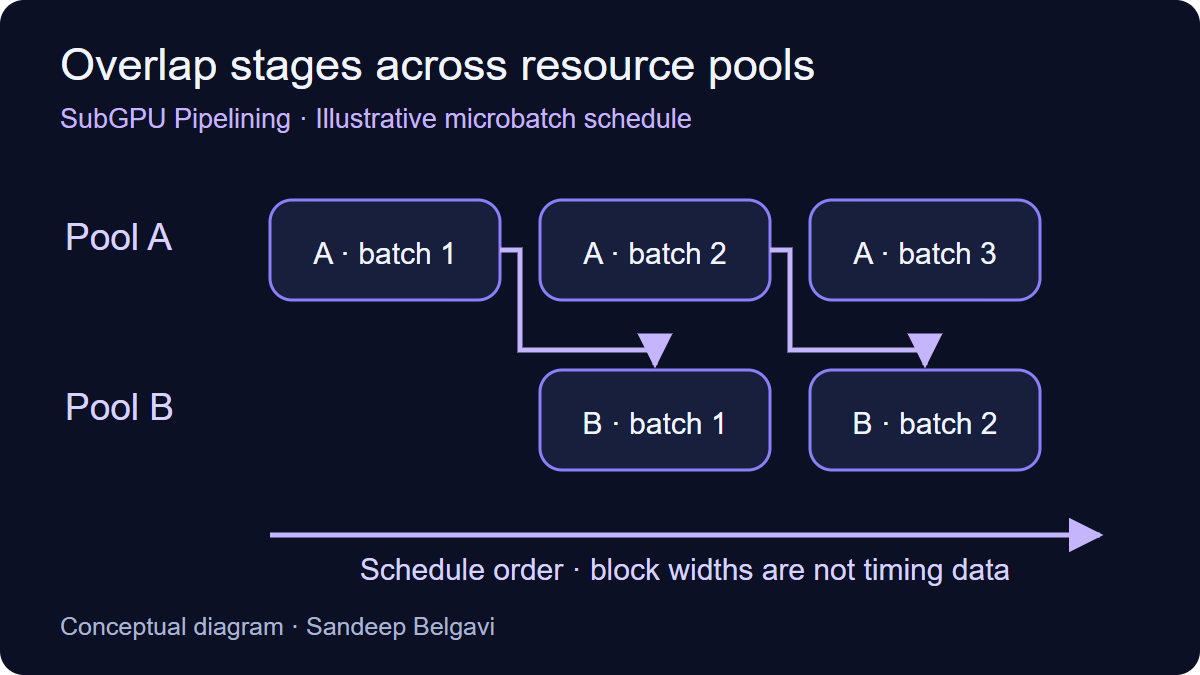
Earlier research, newly covered on November 16: NVIDIA-affiliated researchers submitted SubGPU Pipelining on November 11, 2026. The paper explores splitting a GPU's streaming multiprocessors into groups that execute different parts of an inference graph. Its central systems question is whether useful work can overlap more effectively within one accelerator.
Partition a computation, then overlap its stages
The design assigns contiguous operator segments to disjoint SM pools and streams microbatches between them. Its simulation of GPT-OSS 120B on 32 B200 GPUs reports a frontier offering up to 2.2× per-user throughput at matched per-GPU throughput, or 1.9× per-GPU throughput at matched per-user throughput. Those are modeled comparisons.
The distinction between the two throughput axes is useful even without reproducing the model. A serving system can pursue more output for an individual active request or more total work from its allocated hardware. Reporting a point on only one axis conceals what happened to the other. A fair comparison fixes one condition and makes the remaining tradeoff visible.
What the hardware experiment actually measured
The authors use one B200 to emulate per-rank work, including virtual communication kernels. Their best two-stage configuration reduces a 36-layer iteration from 14.970 to 13.424 milliseconds, a 10.33% reduction. Reported DRAM throughput rises from 71.8% to 83.6% of peak while mean active-SM throughput falls from 85.9% to 71.7%. This is a feasibility experiment, not a measured 32-GPU deployment.
The counters expose a common interpretation trap. More occupied execution resources need not mean a shorter critical path. If memory behavior or stage ordering determines completion, a schedule can improve total time while a utilization measure falls. The appropriate objective is the completed computation under a stated workload; a counter helps explain that result but does not replace it.
A resource partition is not a concurrency guarantee
The CUDA 13.4.2 Green Context documentation warns that disjoint SM partitions do not guarantee concurrent execution or forward progress because other resources can introduce dependencies. That is a constraint to test, not evidence that the paper's experiment failed.
For an implementation review, draw the dependency graph before allocating resources. Each microbatch must reach a stage only after its required inputs are ready, and buffers must remain valid until their consumers finish. A diagram that places two boxes side by side has not established safe overlap. The execution trace must show which completion event releases each dependent operation.
Separate the partitioning policy from the correctness contract. A policy can select different SM shares for different workloads, while the dependency rules remain unchanged. That separation makes it possible to reject a fast-looking configuration if it returns an incomplete tensor or reads a buffer before the producer finishes.
A synthetic sweep with an honest measurement boundary
Proposed experiment, not executed here: build a two-stage graph over synthetic tensors, with one stage chosen to stress memory traffic and the other chosen to stress arithmetic. Compare a serial baseline with partitioned execution while sweeping microbatch size and resource allocation. Keep shapes, precision, warmups, clock policy and correctness tolerances fixed and recorded.
Measure the complete iteration with device events placed around the full dependency chain. Collect stage durations as diagnostic evidence, but do not add overlapping durations and call the sum elapsed time. Check output equivalence on every configuration before considering its timing. Record allocation and synchronization costs separately so a favorable steady-state result does not conceal expensive setup.
A second fixture should deliberately imbalance the stages. The point is to observe whether one pool waits while the other determines completion. A simple CPU schedule illustration can explain that possibility, but it cannot establish GPU performance. Any future numerical claim should name the actual device, software versions, workload and communication assumptions.
What to take forward
The paper supplies a research direction and a bounded hardware demonstration. It does not establish a turnkey serving switch, a general speedup for every model, or an independently reproduced cluster result. The useful takeaway is a measurement discipline: compare full-workload outcomes, preserve both throughput axes, and distinguish modeled opportunity from hardware evidence before choosing a deployment design.
Sources accessed November 16, 2026. Views are my own and do not represent any employer, past or present.
Sources and evidence
Optimize the complete dependency chain, not a utilization counter. Keep simulated serving frontiers separate from the measured single-GPU feasibility experiment.