Treat access changes as normal production events
A person changes teams during an active incident. Their old browser session still exists, a worker job is queued, and a cache contains evidence they previously accessed. A useful isolation design specifies what happens at each boundary after revocation. The local module checks the principal supplied on each call, but it does not refresh a real identity token or update memberships automatically.
Define the maximum tolerated policy staleness for the application and test it through the actual identity adapter. A long-running job should not inherit unlimited access merely because it was admitted earlier. Depending on the task contract, recheck permission before sensitive retrieval or external action and record the decision. Preserve audit evidence without allowing it to become another unrestricted copy of tenant data.
Architecture and request sequence
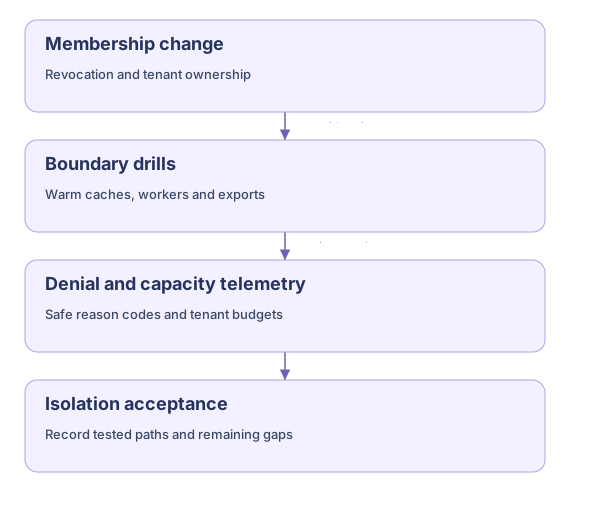
Read the architecture as text
- Membership change: Revocation and tenant ownership
- Boundary drills: Warm caches, workers and exports
- Denial and capacity telemetry: Safe reason codes and tenant budgets
- Isolation acceptance: Record tested paths and remaining gaps
- Membership change → Boundary drills: Classified signal
- Boundary drills → Denial and capacity telemetry: Reviewed evidence
- Denial and capacity telemetry → Isolation acceptance: Controlled response
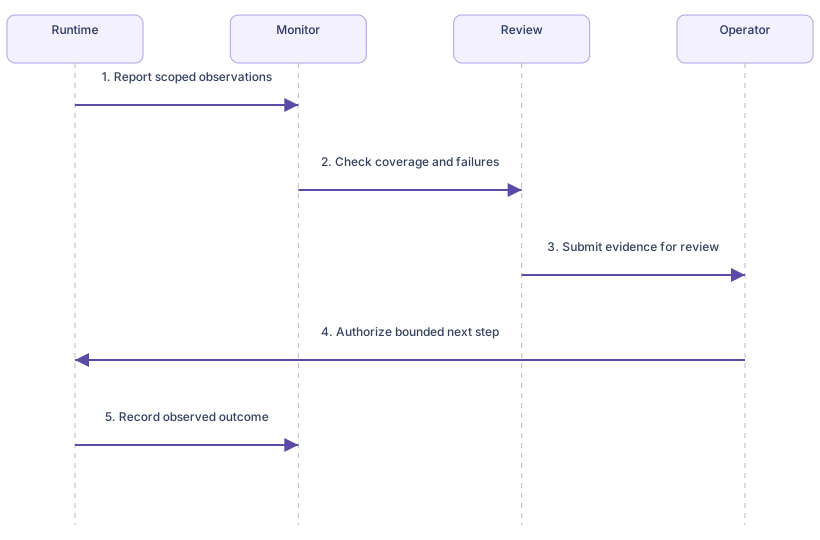
Read the sequence as text
- Runtime → Monitor: Report scoped observations
- Monitor → Review: Check coverage and failures
- Review → Operator: Submit evidence for review
- Operator → Runtime: Authorize bounded next step
- Runtime → Monitor: Record observed outcome
Exercise the paths that ordinary demos miss
Warm a cache under an authorized user, revoke access, and repeat the lookup. Reuse the same incident identifier in two tenants and inspect both retrieval and export results. Queue a background job, change its tenant membership, then resume it. Attempt to alter tenant context in a model tool proposal. These drills target the places where context becomes detached from the original request.
Also test failure behavior. When policy storage is unavailable, a system that silently grants cached access has changed its security contract. Decide which bounded cached decisions, if any, are allowed and why. The default for a new sensitive operation should remain explicit denial until authorization can be established. Record the outage as an authorization failure rather than disguising it as missing incident evidence.
Observe denial without exposing the denied object
Count denied operations by route and reason category, but avoid putting customer names, incident text, or secrets in metric labels. A security analyst needs enough correlation to investigate a pattern without making broad telemetry access equivalent to evidence-store access. Store detailed audit records behind their own controls and retention policy. Apply the tenant boundary to search indexes and diagnostic dashboards as well as the application API.
OWASP's authorization guidance includes appropriate logging and authorization tests. In this original operating model, alerts distinguish invalid identity, missing tenant membership, missing operation scope, and policy-service failure. A surge in denials can be a broken client, expired credentials, or probing; the count alone is not a diagnosis.
Account for the cost of stronger boundaries
Separate worker pools, databases, or encryption keys increase configuration and operational work. Shared resources reduce that cost but require careful policy and context handling. Choose the boundary from customer requirements and the consequences of leakage, not from a generic claim that one architecture is always best. Document who can cross tenant boundaries for support and how that access is approved and audited.
Include deletion and backup restoration in the design. Restoring an old backup can reintroduce records or memberships that were intentionally removed. A recovery exercise should reconcile current policy and retention requirements before serving restored data. Likewise, a tenant export must include only that tenant's permitted records, even when background tooling uses a broader technical identity.
Publish an evidence-based isolation statement
A useful acceptance record lists tested entry points, identities, storage roles, cache behavior, revocation timing, and residual shared resources. It should say which tests ran against real infrastructure and which were local fixtures. Do not label the standard-library example a secure multi-tenant production service; it is a small executable explanation of several necessary checks.
The release owner should be able to demonstrate that unauthorized requests fail before data access, that identical object identifiers remain separated, and that one tenant's limit does not consume another tenant's allocation. Broader claims require broader tests. This makes the isolation statement useful to the engineering team: it identifies a bounded property that can be rechecked after changing a cache, worker queue, or authentication adapter.