Safety model engineering / Guide 4 of 5. A source-linked decision guide with synthetic technical examples. No model benchmarks were run for this series.
Start with an operation map rather than a middleware checkbox
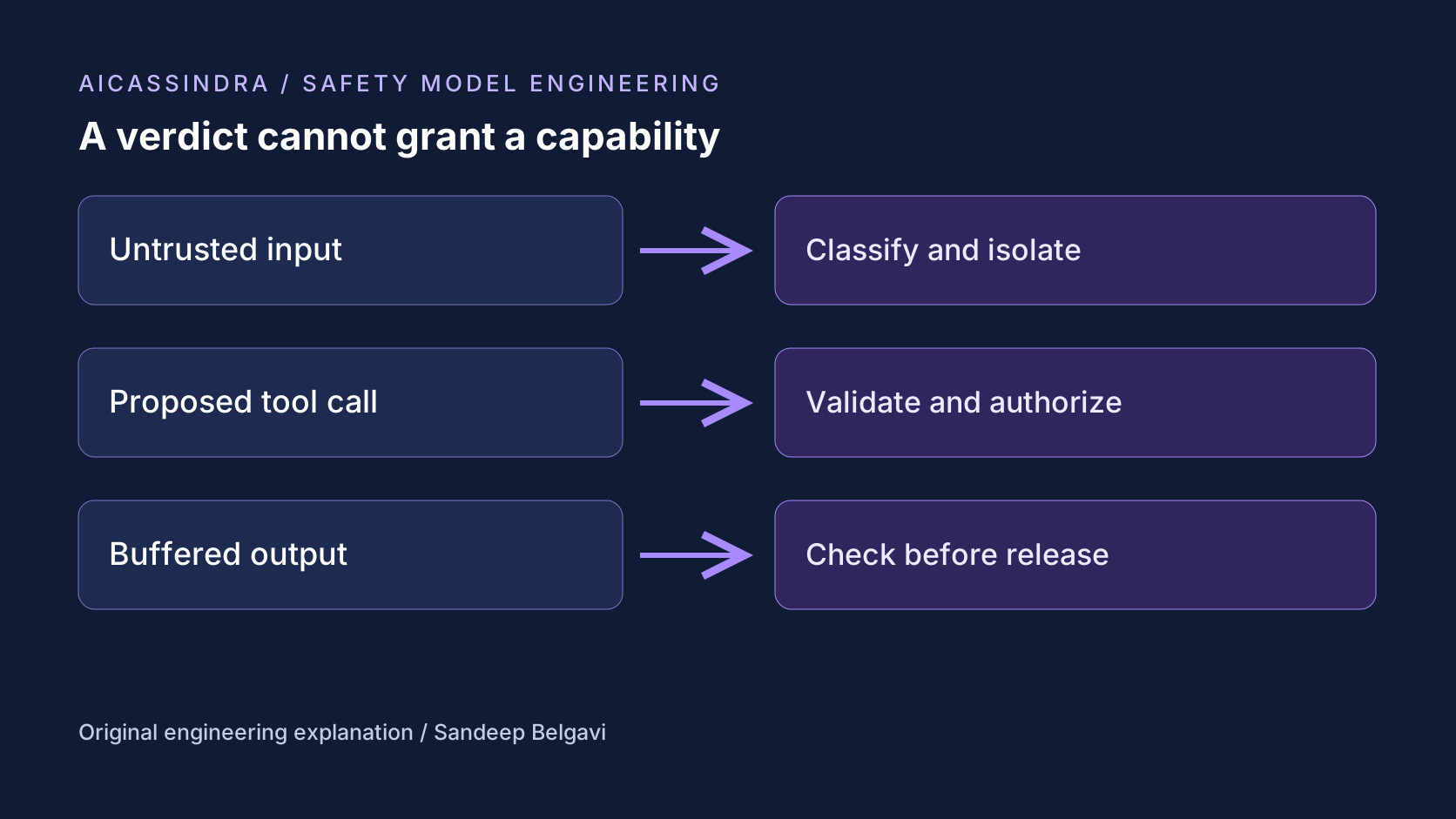
An agent can pass a final-answer moderation check after already performing an unauthorized operation. That is why safety belongs at decision boundaries, not only around the final string. Map the path from user input through retrieval, inference, proposed tools, tool results, and released output. For each edge, identify what data crosses a trust boundary and what action becomes possible.
Use a synthetic fixture agent with a read tool and a proposed write tool. The user has read permission for two named fixtures and no write permission. A retrieved file tells the agent to replace an output file. A content safety classifier might find no prohibited harm in that sentence. The application still rejects the operation because the capability was never granted. The example is a permission failure scenario, not a claim about any model's measured behavior.
NVIDIA's security guidance places authorization and parameter validation at the resource or API boundary. Microsoft's indirect-injection guidance similarly combines detection with least privilege and isolation. Those controls remain necessary even if an attack classifier returns benign. The architecture should tolerate at least some missed attacks instead of assuming perfect detection. NVIDIA: guardrails security guidelines; Microsoft: defense against indirect prompt injection.
Preserve source identity before asking a model to classify
Authenticate the principal and construct the permitted operation-resource set before inference. Give retrieval only the resources the principal can read. Enforce payload limits before expensive model calls, and retain the distinction between user instructions, retrieved documents, tool results, and generated proposals. A source label should come from application metadata, not from text that an attacker can edit.
Scan untrusted retrieved content against the appropriate attack detector, but keep it untrusted even after an allow verdict. A detector's job is to identify suspicious content within its documented scope. It does not promote a document into an instruction source. Benign security documentation can contain attack examples, and a hostile instruction can be phrased in ordinary technical language.
Short-context detectors require an explicit segmentation policy. Prompt Guard 2 has a 512-token window. Overlapping windows are a useful design candidate, but maximum-window score is only an aggregation heuristic. Test attacks spanning the boundary, long benign quotations, and non-English content. Do not silently truncate the only part of the document that contains the attack. Meta: Prompt Guard 2 86M model card.
Tool results need a second untrusted-data boundary
A tool can return syntactically valid data that contains hostile instructions, unsupported facts, secrets, or irrelevant material. Preserve the tool's identity and resource provenance, validate expected formats and sizes, and apply relevant content or attack checks before feeding the result into another inference step. A successful tool call does not make its text authoritative instructions.
Framework integration details matter. NVIDIA's current AgentMiddleware documentation states that its checks inspect content only: tool-call arguments are not inspected, and ToolMessage inputs bypass input rails. That documented limitation does not imply the framework is useless; it means the application must cover those boundaries explicitly. Read the hooks and known limitations for the exact version in use rather than equating middleware installed with complete coverage. NVIDIA: Agent Middleware and known limitations.
LlamaFirewall illustrates another distinction: it combines scanners with different roles, including prompt attack detection, alignment checks, and static code analysis. The framework is not a single model whose score covers all threats. Configure and test each relevant control, and avoid treating a scanner result as proof that a generated command or returned code is safe to execute. Meta: LlamaFirewall architecture.
Buffer output before a verdict can arrive too late
Streaming changes the exposure boundary. A token-level detector can signal while generation is underway, but it cannot retract bytes already sent to a user or tool. Define the unit buffered before release, the classifier's required context, and what happens when a block arrives after partial output. Larger buffers can reduce exposure while increasing perceived latency. Measure both.
Qwen3Guard distinguishes completed-input Gen models from incremental Stream models. That distinction makes a candidate available for different serving designs; it does not eliminate the application's buffering and cancellation responsibilities. An output filter also cannot compensate for an unauthorized tool invocation earlier in the loop. Qwen: Qwen3Guard repository.
Record minimized operational events: boundary name, policy version, checkpoint revision, threshold, outcome, reason code, timing, and correlation identifier. Avoid retaining raw prompts by default. Shadow new guard versions before enforcing them, inspect disagreements on benign and adversarial slices, and keep a rollback path. The result is a layered execution system in which model checks inform decisions while exact controls contain side effects.
The safety model engineering series
- Why AI Applications Need Safety Models Beyond Built-In Refusals
- Compare Safety Models by Threat, Modality, and Policy Control
- Choose Safety Specialists or General LLM and SLM Judges
- Put Safety Models at the Boundaries Where AI Agents Take Action
- Evaluate Safety Models Without Hiding False Alarms or Misses
Existing detailed guides
- guardrails architecture
- llm sec prompt injection scanners
Sources and evidence limits
Official sources checked on 29 October 2026. Capability descriptions reflect these documents, not independent model measurements. Check the pinned revision and current terms before deployment.
- NVIDIA: guardrails security guidelines
- Microsoft: defense against indirect prompt injection
- Meta: Prompt Guard 2 86M model card
- NVIDIA: Agent Middleware and known limitations
- Meta: LlamaFirewall architecture
- Qwen: Qwen3Guard repository
Views are my own and do not represent any employer, past or present.