Safety model engineering / Guide 3 of 5. A source-linked decision guide with synthetic technical examples. No model benchmarks were run for this series.
Compare decision contracts rather than marketing categories
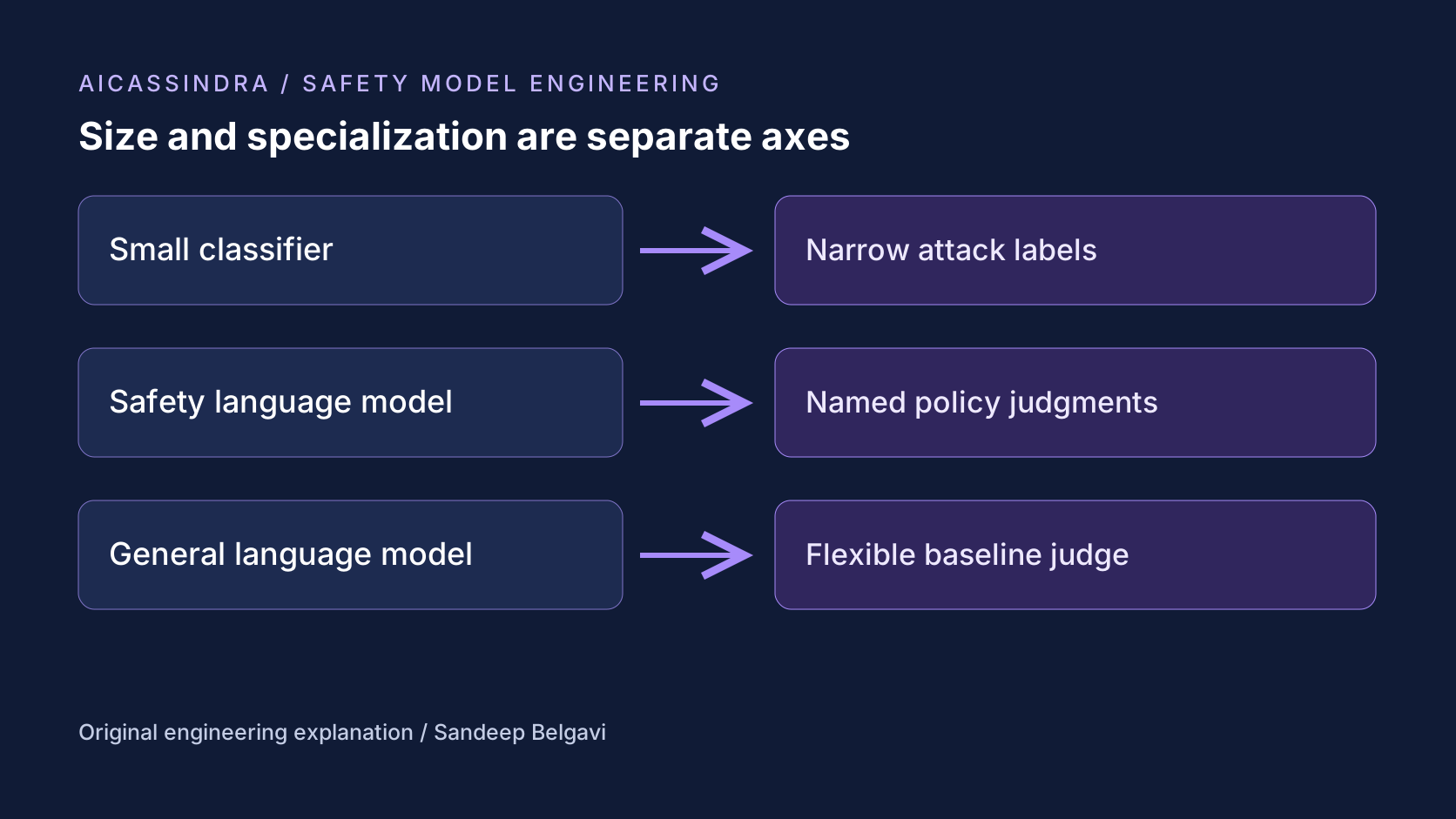
A safety model is not the opposite of an LLM or SLM. It is a model trained or configured for a safety-related decision. A specialized decoder can be a large language model; a compact encoder can be a small classifier. A general SLM can be prompted to judge policy, while a much larger model can be fine-tuned into a guard. Treating those choices as one size ladder hides the actual tradeoff.
Start with the required decision: classify a prompt against named harm categories, detect explicit instruction overrides, judge reference support, or interpret a custom rule. Then specify input structure, labels, uncertainty behavior, supported languages, and permitted downstream actions. Compare candidates that satisfy the same contract. An impressive free-form explanation is irrelevant if the application cannot reliably extract the required verdict.
ShieldGemma demonstrates the overlap directly: its text family consists of Gemma 2 decoder derivatives specialized for safety classification. Prompt Guard 2 demonstrates a different design, with compact binary classifiers. Neither architecture is universally superior. The former can incorporate policy descriptions; the latter offers a narrow attack-label interface. The operating question is which errors and resource costs each design produces on the intended workload. Google: ShieldGemma text model card; Meta: Prompt Guard 2 86M model card.
Specialization helps when its training target matches the boundary
A dedicated classifier can reduce the gap between a model's training task and the application's decision. Instead of asking a conversational assistant to follow an improvised rubric, the application uses a checkpoint designed to emit safety labels in a documented format. A stable label contract simplifies parsing and makes changes easier to compare. These are structural benefits; their practical value still depends on accuracy and scope.
An encoder classifier also avoids generating a long conversational response. That can make it an attractive candidate for a narrow, repeated gate. However, the benefit can disappear if the application needs dozens of overlapping windows, a second model for unsupported cases, or enough contextual understanding to resolve ambiguous quotations. Model loading, tokenization, network transit, hardware scheduling, and queueing all contribute to latency.
Narrow training has a corresponding limitation: a guard is only prepared for some distinctions. A prompt-attack detector can flag an override attempt without knowing whether the requested content is harmful. A harm classifier can reject a prohibited output while missing an authorization violation. Preserve these labels as separate dimensions rather than collapsing them into a single confidence number that downstream code treats as universal risk.
General judges remain useful for policy development and hard cases
A capable general LLM can interpret a complex rubric, explain disagreement, or help draft candidate labels for human review. That flexibility is useful while the policy is changing. A general SLM can also provide a low-footprint baseline if its supported context and instruction following are adequate. The application should evaluate both rather than assuming that specialization automatically wins every ambiguous case.
Flexibility brings a larger prompt-governance surface. Policy text, examples, conversation formatting, and output instructions can change the judge's behavior. Untrusted material inside the item being judged can also try to influence the judge. Research on adversarial attacks against LLM judges demonstrates this possibility for the studied tasks and models; it does not supply a production failure rate for every deployment. Treat the judged material as data and validate the result. Research: adversarial attacks on LLM judges.
A general judge is often valuable as a disagreement reviewer or offline analysis tool. That does not make it an infallible oracle. If it supplies labels for training or evaluation, retain human adjudication of ambiguous and high-impact cases. Otherwise the evaluation can reward agreement with one model's preferences instead of compliance with the intended policy.
Measure the tradeoffs on one policy and one item set
| Dimension | Specialist candidate | General judge baseline | What to measure |
|---|---|---|---|
| Policy fit | Documented taxonomy or fine-tuned criterion | Prompted rubric | Category mapping and unsupported rate |
| Output contract | Labels or prescribed score tags | Structured output or parsed generation | Invalid output and polarity errors |
| Context | Checkpoint-specific limits | Model-specific limits | Long-context and boundary-spanning misses |
| Runtime | Encoder or specialized decoder | General decoder | End-to-end tails, throughput, timeouts |
| Operations | Separate checkpoint and policy versions | Prompt and generator dependency | Change effort and rollback behavior |
Use identical input items and policy definitions. If one model lacks a category, report the gap instead of counting an unsupported case as correct. Separate false negatives from false positives. A model that blocks every item has high recall but no useful discrimination. A model that allows everything has a low false-alarm rate but fails the safety objective.
WildGuard research distinguishes prompt harmfulness, response harmfulness, and refusal, and compares a specialized guard with other judges in its experimental setting. That is useful evidence that the task can be decomposed and evaluated. It is not a timeless ranking across current versions, languages, or policies. Reproduce the decision boundary that matters to the application rather than transplanting a paper's score. WildGuard research paper.
Cost and latency depend on the whole decision path
Count more than parameter totals. A small classifier may run quickly per window but require multiple passes over long documents. A policy reasoner may use additional generated tokens. A hosted judge adds network transit and rate-limit behavior. A local service adds capacity and maintenance costs. Quantization, batch size, concurrency, cold starts, and shared accelerator load can change the outcome.
For a hypothetical request, define total latency as queueing plus preprocessing plus all serial inference stages plus enforcement and delivery. Independent checks can sometimes run in parallel, but they still share resources and their slowest required result gates progress. Report p50, p95, and p99 under a stated load. A single warm request on an idle machine does not describe an interactive service under contention.
Total operating cost includes classifier inference, any generator calls avoided, retries, review work, false refusals, incident analysis, and maintaining the policy mapping. A cheaper inference call can create a more expensive system if it produces many avoidable reviews. Without workload and hardware measurements, neither an SLM nor a specialist deserves a blanket cheaper or faster claim.
Adopt the smallest system that meets the measured requirement
Begin with exact validation and a simple baseline. Add a specialist when its supported decision and measured errors justify the additional dependency. Retain a general judge when complex criteria or disagreement analysis make it useful. If deterministic code already resolves the requirement, adding another neural model increases operational work without an established benefit.
The selection record should name the chosen revision, policy, templates, thresholds, evaluation slices, resource envelope, and fallback behavior. It should also record rejected alternatives and why they failed a requirement. Google recommends application-specific evaluation in addition to public benchmarks; that is the evidence needed to claim that one option works better for a particular application. Google: safety evaluation.
Better therefore means fewer unacceptable misses at an acceptable false-alarm rate, latency, and total cost for a stated policy. It does not mean more parameters, more reasoning text, or a safety label in the model name. Preserve that definition when the model or policy changes, and re-run the comparison rather than treating the initial choice as permanent.
The safety model engineering series
- Why AI Applications Need Safety Models Beyond Built-In Refusals
- Compare Safety Models by Threat, Modality, and Policy Control
- Choose Safety Specialists or General LLM and SLM Judges
- Put Safety Models at the Boundaries Where AI Agents Take Action
- Evaluate Safety Models Without Hiding False Alarms or Misses
Existing detailed guides
Sources and evidence limits
Official sources checked on 29 October 2026. Capability descriptions reflect these documents, not independent model measurements. Check the pinned revision and current terms before deployment.
- Google: ShieldGemma text model card
- Meta: Prompt Guard 2 86M model card
- Research: adversarial attacks on LLM judges
- WildGuard research paper
- Google: safety evaluation
Views are my own and do not represent any employer, past or present.